
Contact Us
GF MGD Bldg. Brookside, Cainta, Rizal 1920
+63 936 298 2810
venderitsolutions@gmail.com
Get a Quote
From Facebook Page to Full Website: Why It Matters
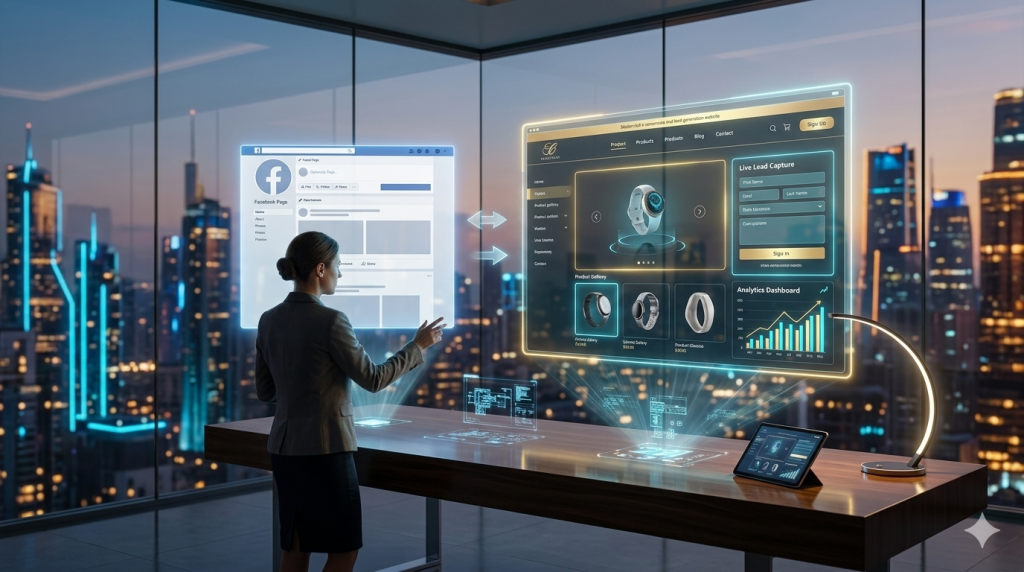
Many business owners start their journey on social media because it is fast and free. However, when comparing a facebook vs website presence, relying solely on a social profile creates significant risks for long-term growth.
As we move into 2026, the digital landscape demands more than just a social media presence. Transitioning to a professional website allows you to own your audience, control your branding, and implement advanced revenue-generating tools.
Understanding the Facebook vs Website Debate
The core difference in the facebook vs website debate is ownership. While Facebook provides a massive audience, you are essentially building your business on rented land where the rules can change overnight.
A website serves as your digital headquarters, providing a permanent address that search engines can index reliably. Furthermore, it offers a level of professional credibility that a social media page simply cannot match in a competitive market.
Ownership and Control of Digital Assets
When you use social media as your primary platform, you are subject to algorithm shifts that can slash your reach instantly. Therefore, a major advantage in the facebook vs website comparison is the total control over your content.
- No Algorithm Barriers: Your website visitors see exactly what you want them to see without a third party filtering your message.
- Custom Functionality: You can add specialized tools like booking systems, calculators, or membership portals that social media lacks.
- Permanent Content: Your blog posts and pages remain easily searchable and accessible forever, unlike social posts that disappear in hours.
SEO and Search Engine Visibility
Social media pages have limited visibility in search results. Specifically, when potential customers search for specific services on Google, a professional website is far more likely to appear on the first page.
By optimizing your site for local and global search terms, you attract high-intent traffic that is ready to buy. Consequently, this organic growth is much more sustainable than the “pay-to-play” model often required to get noticed on social platforms.
Professional Credibility and Brand Trust
In 2026, savvy consumers view a dedicated website as a sign of a legitimate and stable business. Because of this, relying only on a Facebook page can make your brand appear temporary or small-scale.
A professional site allows you to showcase high-quality portfolios, detailed case studies, and verified testimonials in a structured way. This builds immediate trust with visitors, leading to higher conversion rates and better client retention.
Advanced Data Insights and Analytics
While social media provides basic metrics, a website integrated with modern analytics offers deep insights into user behavior. For instance, you can track the exact journey a customer takes from the first click to the final purchase.
This data is invaluable for refining your marketing strategy and increasing your ROI. Moreover, owning this data allows you to create highly targeted remarketing campaigns that are not restricted by social media platform limitations.
Monetization and E-commerce Flexibility
Selling products or services is much more efficient on a dedicated platform. When comparing facebook vs website capabilities, a website offers a streamlined checkout process that reduces cart abandonment.
You can integrate multiple payment gateways, offer discount codes, and manage inventory with precision. This level of automation ensures that your business can scale without a proportional increase in manual administrative work.
Building an Email List and Direct Access
One of the most dangerous facebook vs website risks is losing access to your followers. If your social account is flagged or deleted, you lose your entire connection to your audience instantly.
A website allows you to capture email addresses and phone numbers through lead magnets and newsletters. As a result, you build a direct line of communication that you own entirely, providing a safety net for your marketing efforts.
Customizing the User Experience
Social media platforms force every business into the same visual template. In contrast, a website allows for complete creative freedom to reflect your unique brand identity through colors, fonts, and layouts.
A tailored user experience keeps visitors engaged longer and guides them toward specific calls to action. Additionally, this professional environment minimizes distractions from competitors’ ads or notifications, keeping the focus entirely on your value.
Scalability for Future Growth
As your business expands, your digital needs will become more complex. A website can grow alongside you, whether you need to add an international storefront or a multi-lingual support center.
Social media profiles are limited by the platform’s features, which are designed for social interaction rather than enterprise-level operations. Therefore, starting with a solid website foundation is essential for any business planning to dominate its niche.
Conclusion: The Strategic Choice
While social media is a great tool for engagement, it should never be your only digital home. The facebook vs website comparison clearly shows that a professional site is the most important asset for any growing brand.
However, the best strategy is to use social media to drive traffic to your website. This combined approach allows you to leverage the reach of social platforms while maintaining the security and authority of your own digital headquarters.
Ready to elevate your business with a high-performance website? Contact VenderIT today to build a digital presence that drives results.
Ready to build your professional website?
Contact VenderIT today to start your digital transformation.Get Started Now